Unveiling the Thrills: CS2 Case Opening Reveal
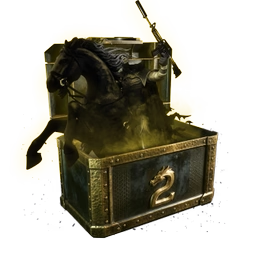
Few phenomena in modern gaming have captured the global imagination quite like the virtual weapon case in Counter-Strike: Global Offensive (and its continuation in Counter-Strike 2). What started as a cosmetic addition in the 2013 “Arms Deal” update has evolved into a multi-million-dollar digital economy, a subculture of streamers, and a modern-day lottery that captivates millions.
For the uninitiated, the process looks simple: buy a key, click a case, watch the digital barrel spin, and hope for a knife. However, beneath the flashing lights and dopamine-inducing animations lies a complex matrix of statistics, probabilities, and economic forces.
This guide explores the mechanics behind CS:GO case openings, the mathematical realities of the drop rates, and how players approach this digital pastime.
Understanding the Mechanics: How Cases Work
To participate in a case opening, a player needs two things: a virtual case and a corresponding key. Cases drop randomly during active gameplay (by playing on official or community servers) or can be purchased directly from the Steam Community Market. Keys, conversely, cannot be traded immediately upon purchase and must be bought at a flat rate—typically around £2.50 GBP—either in-game or via the Steam Store.
Once a key is applied to a case, a visual roulette wheel begins to spin, cycling through various weapon finishes before landing on a single item. The item is then deposited directly into the player’s Steam Inventory, where it can be kept, equipped, traded with other players, or sold on the marketplace.
The Weapon Wear System
Every weapon skin pulled from a case is assigned a float value ranging from 0.00 to 1.00. This float determines the physical wear and tear of the skin, categorized into five distinct conditions:
- Factory New (FN): 0.00 – 0.07
- Minimal Wear (MW): 0.07 – 0.15
- Field-Tested (FT): 0.15 – 0.38
- Well-Worn (WW): 0.38 – 0.45
- Battle-Scarred (BS): 0.45 – 1.00
Some cases also have a chance to drop a StatTrak™ variant, which features an attached LED counter tracking the number of kills made with that specific weapon.
The Mathematics of Probability: What Are the Odds?
While Valve, the developer of the game, does not officially publish the exact percentage rates for every single item due to Chinese legal requirements forcing disclosure, extensive data collection by the community over millions of openings has revealed the baseline probabilities.
The table below outlines the estimated drop rates for weapon rarities in standard CS:GO cases:
| Rarity Category | Item Tier Color | Estimated Drop Rate |
|---|---|---|
| Consumer / Base Grade | Light Blue | N/A (Standard drops only) |
| Mil-Spec Grade | Blue | ~79.92% |
| Restricted | Purple | ~15.98% |
| Classified | Pink | ~3.20% |
| Covert | Red | ~0.64% |
| Special Item (Knives / Gloves) | Gold | ~0.26% |
The Reality of the “Gold” Drop
That 0.26% chance means that, on average, a player will need to open roughly 385 cases to statistically encounter a knife or pair of gloves. Of course, probability is independent per trial; a player could theoretically open a knife on their very first try or fail to hit one after opening a thousand cases.
Furthermore, within the “Gold” tier, there are different tiers of rarity based on the specific knife model, finish, and whether it features a StatTrak™ mechanism. High-tier items like a Karambit | Doppler (Ruby) or Factory New Pandora’s Box Sport Gloves possess astronomical rarity values, driving their real-world cash value into the thousands of dollars.
The Psychology and Appeal of Opening Cases
Why do millions of players continue to open cases despite the overwhelmingly unfavorable mathematical odds?
- The Thrill of the Unknown: The visual and auditory feedback of the spinning wheel triggers a rush of dopamine similar to traditional gambling.
- Digital Status Symbols: Owning rare skins allows players to showcase their individuality, wealth, or dedication to the game within matches.
- The Investment Angle: Over the past decade, certain discontinued cases and rare skins have appreciated significantly in value, leading some to view case openings—or holding unopened cases—as a speculative financial investment.
Best Practices and Safe Approaches
For those who choose to partake in case openings for entertainment, keeping a few best practices in mind can ensure a healthier gaming experience:
- Set a Strict Budget: Treat case opening strictly as entertainment, akin to buying a ticket to a movie or visiting a casino. Never spend money you cannot afford to lose.
- Consider Direct Purchasing: If a specific skin is desired, buying it directly from the Steam Community Market or a reputable third-party marketplace is almost always cheaper than trying to unbox it.
- Beware of Scams: The secondary market for CS:GO/CS2 skins is lucrative, which unfortunately attracts malicious actors. Never click unverified links, log into third-party sites with your Steam credentials carelessly, or trust unsolicited trade offers.
Frequently Asked Questions (FAQ)
Are CS:GO cases considered gambling?
Legally and regulatory-wise, the classification varies by country. Because items have real-world monetary value and the acquisition relies on randomized chance, many jurisdictions view loot boxes as a form of gambling, leading to bans or restrictions in countries like the Netherlands and Belgium.
Can you make a profit by opening cases?
Statistically, no. The expected value (EV) of opening a standard case is significantly lower than the cost of the key and the case combined. While individuals occasionally hit rare items and make a profit, the vast majority of openings result in financial loss.
What happens to old CS:GO cases?
When newer cases are introduced, older cases typically move to the “rare” or “low-drop” pool. This means they drop very infrequently at the end of matches. As supply dwindles and demand remains steady or rises, the market price of these older cases often increases over time.
What is a Trade-Up Contract?
A Trade-Up Contract allows a player to trade in ten weapon skins of the same wear tier (e.g., ten Mil-Spec weapons) for one weapon skin of the next higher tier from any of the collections represented in the trade. This is an alternative method used by players to target specific higher-tier items without opening cases directly.
Try CSGO Cases on CS2Skin to uncover CS2 skin possibilities, enjoy a smooth experience, and chase standout virtual drops.